Sunday, 16 September 2012

Mayor of London Discovery Trails - Pink Route

Tourist Wenlock
After the success of our trip along the Green Route of the London Mayor Discovery Trails a couple of weeks earlier we decided that we would have a stand alone trip to London and try some of the other routes.  We started with the shortest trail, the Pink Route, which took us around a loop including famous sights such as Covent Garden, the Embankment, Trafalgar Square, Leicester Square and Chinatown.

Covent Garden Flags

We started our trail in the Market Hall of Covent Garden.  This is always a favourite haunt of ours when we come to London.  Although I cannot profess to be a keen shopper, even I am interested in the shops here as it is possible to find things that you wouldn’t otherwise see anywhere.  I even profess to finding things I never knew I needed!  The market was, as usual, buzzing with people looking around the market stalls and enjoying the street entertainment.  Most attention was on a magician and these types of act do seem to be particularly popular on the street.
Michael Faraday

Inside the hall the most delicious smells were wafting past our noses as the food vendors vied for our business.  Despite the aromas of German sausages, paella and deep fried delicacies we stayed strong and began our mission to find the 13 mascots on this particular route.  Lunch would have to wait, at least until we had made some progress as after all, it was still only 11am!

Somerset House

We didn’t have to venture far to find the first two mascots (see the entry for the Green Route for a full explanation of what they are and why they are here).  We had one of each mascot in the Market Hall at each end of the building.  Mandeville was a flower seller (which used to proliferate here, but which seem to be fewer in number these days), while Wenlock was painted up as a tourist (which seem to have increased in  number).

Somerset House Mandeville

Our route took us east of the Market Hall towards the Theatre Royal in Drury Lane and we passed the third mascot, which was equally appropriate for the area – the busker.  By now my girls had got themselves into posing mode already and their favourite game was to try and emulate the pose of the mascot statues.  Despite the limited number of poses this would be a game they never tired of!

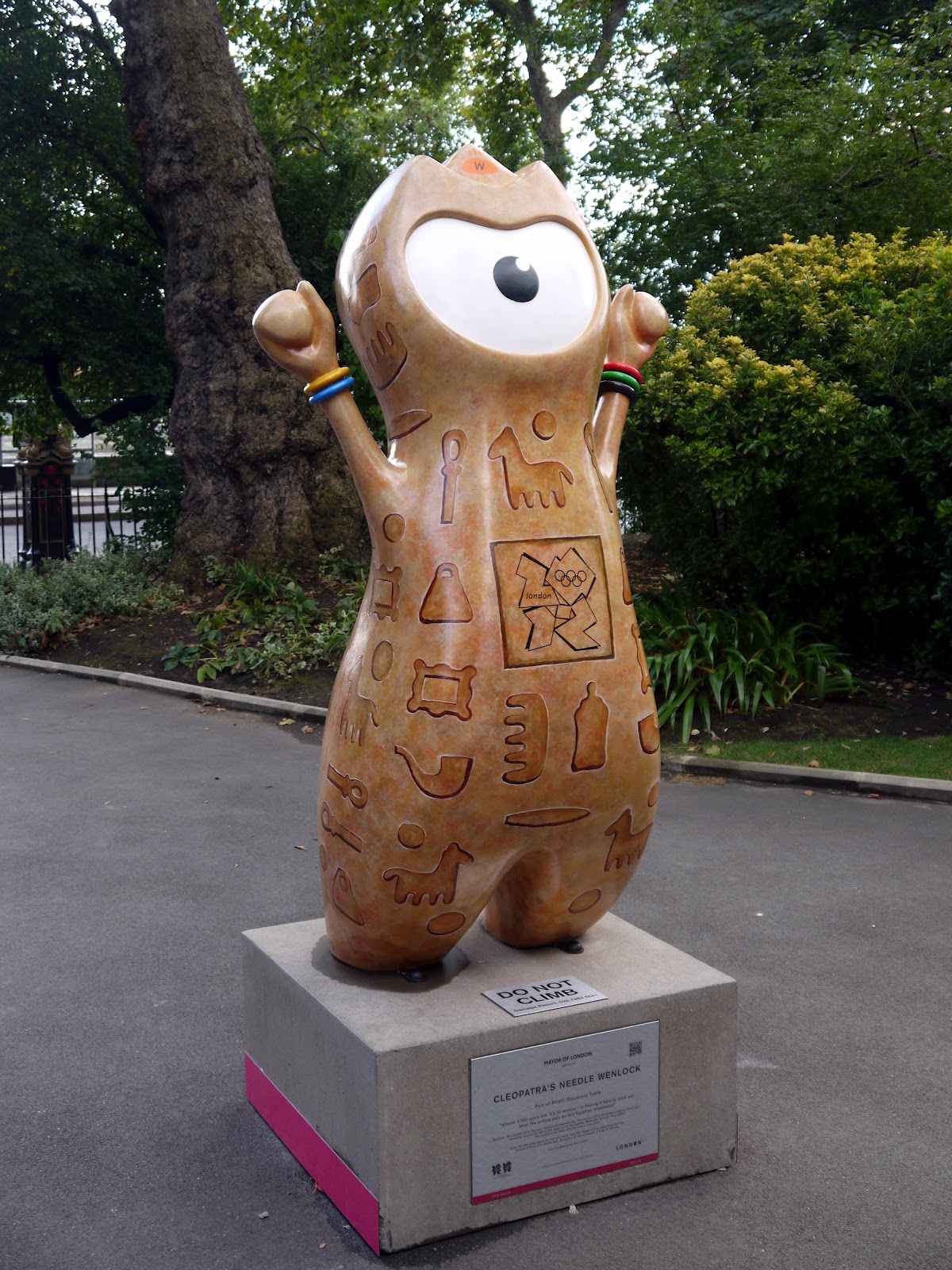
Cleopatra's Needle Wenlock

As well as the busker statue the show at the Theatre Royal caught their eye as it was Shrek The Musical.  I am sure at some stage we might have to go an watch it, as both girls are big fans of Shrek.  I was rather more interested in the building, although compared to some of the theatres around this was rather a plain looking building.  Further down the road on the edge of Aldwych, the Novello Theatre (showing the Abba Musical Mamma Mia) was a much more elaborate looking building.  In both cases though, the buildings were far more ornate than any current one would be.  It made me speculate about the approximate time that we lost this decorativeness from our architecture.  Personally I blame World War I – architecture has never really been the same since.

Embankment Wenlock

Our next Wenlock was the standard mascot – no extra decoration.  The kids didn't seem to mind - they still posed by it.  We walked down Aldwych and crossed the road when we reached The Strand, heading down towards the Embankment.  

Patriotic Flower Basket

The next mascot was by Somerset House, an old Georgian building that has had a multitude of uses over the years but which now hosts the science stuff.  Outside was a statue of Michael Faraday, gleaming in the sunshine.  My older daughter was thrilled to be photographed by him – she is a big science fan despite her tender years.  I’m not sure she knew who Michael Faraday was, but she definitely knew he was important otherwise why would he have a statue there?

Novel Wenlock

Outside Somerset House was the very pink Somerset House Wenlock.  He was particularly striking in the sunshine, although ominously overhead a very large black cloud came across and blocked further sunshine for the next half an hour or so.  It was a shame for the next part of our walk was through the unsung and yet lovely gardens of Victoria Embankment.  This is a green space I had never previously been to but was pleasantly surprised by the wonderfully cheerful planting (yellow and red/white/blue seemed to be popular colour schemes) and the range of statues of predominantly famous Victorians.  I guess many of them were the celebrities of their day and included Robert Raice (founder of Sunday Schools), Robert Burns and Sir Wilfred Lawson (prominent politician).

London Coliseum

At the far end of the gardens we passed a big area of deckchairs, laid out we assumed for some future show rather than for musical chairs, and a couple of pin pong tables that were well used (perhaps this will be part of the legacy of the Olympics?).  From the relative calm of the garden we were plunged into the more frenetic environment of the street running down the side of Charing Cross Station.  This too seemed to be something of a hotbed of eating establishments and many were already doing a brisk trade despite the early hour.  I guess that the proximity of Charing Cross station helps in that regard.

Medal Tree at Leicester Square

We passed by the front of the station (said to be the very centre of London) and crossed to St Martin-in-the-Fields Church, so called because it was once literally in the fields, between what was once the twin cities of London and Westminster.  It is hard to imagine there being any green space in this part of London now, so built up is it.  At the back of the church was Novel Wenlock and round to the front was Trafalgar Square Wenlock, although this was actually sited in a secluded corner of the famous Square.

Filmstar Wenlock

Our onward route took us past the National Gallery and into Leicester Square.  I hadn’t really appreciated how close to Trafalgar Square it really was before – it’s amazing how little you can appreciate the layout of a city when you travel underneath it by Tube.  Perhaps this was the best part about walking the trails – putting the city into context.

London Hippodrome

Leicester Square seemed to have medals growing from the trees – rather an interesting art installation but perhaps the nearest that us mere mortals will ever get to being able to obtain an Olympic medal!  We passed the huge and imposing Odeon Cinema and found the colourful and popular Filmstar Wenlock, a nod to the film industry that has viewing headquarters here. 

Spotlight Mandeville

By now, we had worked up something of an appetite and took a relaxed and lengthy lunch break.  On resumption of our walk we passed by the Hippodrome and Haymarket, finding the Spotlight Mandeville lurking behind another theatre.  It was perhaps the hardest one to find on the whole route. 

Chinatown Mandeville

The route continued up through the streets to the west of Covent Garden and skirted Chinatown, where we would find a Mandeville done up in the blue associated with Chinese pottery.  It was perhaps one of the classiest designs on the route.  Finally we made our way back towards Covent Garden and found the last Wenlock (Performer) just along from the Underground Station.  All along the way we looked in some of the windows of shops selling delicious chocolates and cakes.  Although tempting, it was a bit hot for such delicacies and we sadly left them in the windows for others to purchase.

Seven Dials

This was a good appetiser for the day.  Only modest in length (2.6km), the walk actually seemed an awful lot longer such was the amount packed into the route.  We completed quickly and still with lots of energy in the tank for the next route, starting nearby at Picadilly Circus.  For a full view of all the pictures on the route please take a look at my Flickr set at Pink Trail Set

Performer Wenlock

Tuesday, 11 September 2012

Mayor of London Discovery Trails - Green Route

Rainbow Mandeville

During our trips to the Olympic Games this year we were struck with the incredible atmosphere surrounding the whole of London.  On our last trip we decided to have a tour around the city and get a look at all the decorations, banners and flags that had been put up for the festival.  While plotting where we should go we came upon the Mayor of London Discovery Trails, six routes around the city marked by a total of 82 statues of the mascots, Wenlock and Mandeville, painted to represent different themes of London

Union Jack Wenlock Getting Attention

The official blurb for the routes was as follows “Stroll Discovery Trails provided the opportunity to take a stroll along some of London’s most scenic streets. We put together six unique walking routes across the historic city centre that took people on a journey of discovery to the greatest sights and sounds of London. The trails were brought to life by our official Games mascots Mandeville and Wenlock, who highlighted some great photo opportunities. Each Mascot was individually designed, animating the routes in a unique way that captured the spirit of London. A large number of people tried out all of the trails and sent us photos of their favourite London 2012 Games mascot.”

Busy Park
The mascots were rather an acquired taste – many people didn’t warm to the one-eyed representations.  The back-story behind them perhaps explained their appearance, but I’m not sure this was explained very well. According to the associated (fictional) storyline, they were formed from the last girder of the Olympic Stadium. Their skins are made of highly polished steel allowing them to reflect the personalities and appearances of the people they meet. Their one eye is a camera and on their heads are yellow lights symbolizing those of a London taxi.
Feisty Goose

Wenlock’s name was inspired by Much Wenlock in Shropshire, England, where the Wenlock Olympian Society held its first Olympian Games in 1850, regarded by some as an inspiration for the modern Olympic games. The five friendship rings on his wrists represents the Olympic rings, and three points on his head represent the three places on the podium. The pattern on his body symbolises the whole world coming to London, and the shape of his helmet is supposed to represent the shape of the Olympic Stadium.

Colourful Beds

Mandeville is named after the Stoke Mandeville Hospital in Aylesbury, Buckinghamshire, which organised the first Stoke Mandeville Games for the first time in 1948, which is considered to be the precursor to the Paralympics. The three spikes on Mandeville's helmet represent the Paralympic Agitos.

Boating Lake
We started with the Green Route, for no better reason than it was completely in Regents Park, and would give our children the opportunity to explore without us worrying about traffic (it was the only traffic-free route).  Due to the vagaries of our bus route we actually entered the Park in the south-east corner, which meant that we would come across the 11th and last mascot on the route first.

Junior Pedalos
So our first mascot was called Rainbow Mandeville and it said on its plaque “My adventures on a rainbow have taken me all around the UK. I've met so many inspirational people and learnt so many things”.  Its design was colourful and striking and immediately struck a chord with the children.  It soon became obvious as we wandered around to the next one that there were many other people doing the same as us.  We had to vary our pace to ensure that there wasn’t a traffic jam for people waiting to get their pictures taken with the statues.
Safari Mandeville

As for Regents Park, this was our first time exploring and we liked what we saw.  The flower beds and planting schemes were in particularly fine fettle and we speculated whether there had been more money spent on them this year, given how many eyes would be on London.  Sadly the Park would not play a part in the Games themselves, rumours of baseball and softball being hosted here were squashed when those two sports were dropped from the programme for London 2012.

Animal Wenlock
The popularity of the mascots was soon apparent when we reached the next one – the very patriotic looking Union Jack Wenlock.  The girls had to queue to get their picture taken!  After this mascot we had assumed that we would get on track and follow the rest of the trail as per the numbered sequence but had not realised that the bridge across the canal-like waterway that we were following was being extensively repaired and was therefore closed.  This proved an annoyance as we had to re-jig the route considerably, passing along the side of the boating lake towards the next available mascot.

Regency Mandeville
We took the opportunity to have our picnic alongside the lake and enjoyed watching the large number of people rowing and pedalling their way around the boating lake.  It made for an exquisite summer scene, something of a rarity this year!  All around the edge of the park the beautiful architecture of the buildings overlooking this green space added a good deal of additional class.  Alongside the lake were large numbers of water birds, from herons to little sparrows, all seeming to be unaffected by the large numbers of people wandering about.  Indeed many of the birds used the people as opportunities and there was much scrounging for food going on!

Birdy Wenlock
After some lunch we pushed on, eventually finding Safari Mandeville next and then Victorian Mandeville at the far end of the Park.  In addition to the mascots the girls were quite fascinated by the antics of the squirrels – there certainly seemed to be plenty of them and most were very busy! 

Photo Opportunity
As we headed on to the next mascot the mood of the Park changed.  Gone were the flower beds and wild birds to be replaced by sports, including incongruously for the summer lots of football.  There were also cricket and baseball games going on and the Park was alive with a competitive yet friendly atmosphere.  Is this what the Olympics are supposed to be inspiring?  I do hope so – it was lovely seeing so many people enjoying the fresh air.
Black Eyed Susans

Our onward route was quite convoluted as we had to double back on ourselves after seeing Animal Wenlock and Regency Mandeville.  As each mascot went by we began to appreciate the thought that had gone into all these mascots and their positioning around the trails.  The Animal one represented the famous London Zoo that sits to the north of the Park, while Regency represented the history of the Park.

Jubilee Gates
From the frenetic sporty part of the Park we curved around through a quiet part of the Park, beloved of swans and small birds only.  There were far fewer people around too, belying its location in the centre of London.  The remaining mascots were found in quick succession; Birdy (which was probably my youngest daughter’s favourite), Rose Garden and Midsummer Night’s Dream (named after the play being staged in the Park throughout the summer).  A short walk around the Inner Circle brought us to Deckchair and Sherlock (named after the nearby Baker Street location of the famous sleuth). 

Sea of Yellow
By now we were rather hot and bothered and took the opportunity to have an ice cream.  This last part of the Park was possible the best of all.  The centre of the Inner Circle was awash with flowers, especially roses in what I later learned was a famous garden known as St Mary’s Garden.  This part of the garden was also surrounded by some decorative iron fencing and entered via some exquisite gates that had been put here to commemorate the Silver Jubilee of King George V in 1935.  The final jewel in the crown for us though was the sculpture of a gardener made completely out of live plants.  This was a lovely sight to finish with!

Green Gardener
Our first experience of the Mayor of London Discovery Trails was very positive.  The girls loved finding the mascots and we thought they were very imaginative and fun.  We were also pleased that the trail had given us the opportunity to visit the Park, something we might not otherwise have done.  It was such a popular activity that thoughts turned to completing the other five.  A tall task, given that we would be on a limited timetable – all the mascots were due to be removed after the closure of the Paralympic Games on 9th September. For a full catalogue of the mascots please see my Flickr set at Flickr Green Route


Wednesday, 5 September 2012

Velorail La Ferté-Gaucher

Lescherolles Station
As has now become customary for our holidays we found ourselves a velorail expedition to do on the day after we had completed a visit to Disneyland Paris.  The velorail at La Ferté-Gaucher is the nearest to the resort, but could be a million miles away given how rural the surrounding area is.  


Getting Ready for the New Travellers
This velorail is one of two established on the old line from Paris to Sézanne (the other is at Esternay some 30km or so further east).  The original line was built in 1853 and ran until 1972 but has been truncated in stages until La Ferté-Gaucher, which had been a terminus station, lost its trains in 2002 and the station is now served by bus from Coulommiers.  The station in La Ferté-Gaucher is still in pretty good looking condition should the line reopen, but the track heading westwards towards Paris is pretty overgrown in places and would need a complete replacement.  The line east from La Ferté-Gaucher has been removed through the town and now acts as a greenway for horse riders, cyclists and walkers.

Ready to Go!

We had initially assumed that the velorail operation would start at the station but we were obviously mistaken as the relative positions of the track either side of the station told us.  Despite the fact that the velorail had been signposted for some distance from the town the signs dried up as soon as we reached town and it took us some time to realise that the place where we were supposed to report to was actually the Tourist Office in the centre of town.  The reason that this was the case soon became obvious when we had to board a land train to take us out to Lescherolles station, about four miles away.


Must Get Off!
Lescherolles served what could be said to be a scattered community and it is hard to imagine that it ever warranted enough business for a station of the size provided.  In velorail terms it would seem to be big enough to cope with visitor numbers but I am guessing that parking would be a major problem and arriving by land train is probably the most efficient way of bringing in visitors.  The land train takes the route that would formerly have been taken by service trains before their cessation in 1972.  The old line is now a linear nature reserve, home to many wildflowers, butterflies, insects and other fauna.  The guide on the train waxed lyrical about these facts, but I think we only got a very edited version in English.


Through the Woods
At Lescherolles we transferred to the velorail, opting for a cycle towards the back of the queue.  As with all the other operations that we have visited since Pont Erambourg we set off at appointed times heading out as a continuous group.  We were given a new instruction on this route.  If we were faster than the cycle in front we could ask them to swap bikes so that we could then pedal at the optimum speed.  


More Obstacles
Our route would largely follow the Grand Morin River and the line adopted a fairly windy course along the valley for six kilometres until we reached the next station at Meilleray.  It was an extremely hot day and so the initial section through a heavily wooded section of the valley was quite welcome.  We had managed to develop a bit of a gap both in front and behind us, which meant that we could go at a pretty steady pace.


La Chapelle Moutils

All along the way the woods were full of butterflies, all similar species to those we would find in the UK and especially Red Admirals, which seemed to enjoy these surroundings.  Our brochure showed some points of interest to stop at along the way, but we had been discouraged from doing this on the way out so we passed by the intriguingly named Peter of the Fairies (maybe something to do with the butterflies?), the fauna and the Grand Morin River signboards.  Some of the rail features we were expecting fell a little short of expectation (such as the river viaduct, which was rather shorter and closed in by trees than we imagined), but overall it was a pleasant ride.

Crossing Keeper's Cottage
Along the way we came upon a couple of level crossings.  These were clearly busy enough to impede our progress as they were protected by bungee cords that prevented us from proceeding unless we got off the rail cycle (as required).  Looking at how busy these roads probably were it did seem unlikely that we would be involved in any kind of incident, but I guess the authorities were playing it safe.

Grain Silo
Eventually, just as we were both tiring of the trees and the long slow climb that we had done so far, the line levelled out and we lost the trees entirely.  What followed was a very pleasant trip through ripening wheat fields, already golden and presumably not long before harvesting.  Up on the hill above us was the small village of La Chapelle Moutils, with a very striking looking church that dominated the landscape that it overlooked.

Speeding Onwards
We rattled along at quite a pace along this section of track, the clunks of the rail joins making the distinctive clickety-clack sound that is sadly missing from so many railway journeys in the modern world.  The track was in pretty good order too, a far cry from the poor quality ride that we experienced in Perigord last year.  After ambling through the Morin Valley fo another couple of kilometres and negotiating a couple more level crossings we arrived at the final destination of Meilleray, signified by an old mill building that no longer fulfilled that purpose but served instead as rather a plush looking house.  A large white grain silo dominated the scene although this is clearly now served by road (if at all).

Meilleray Station
The road by the mill was an unprotected crossing but staff from the velorail operation were on hand to direct any traffic that might materialise using good old fashioned flags!  Just beyond the crossing and we entered the station at Meilleray, which presumably served an equally scattered community.  How it remained operational until as late as 1972 was a mystery – clearly the authorities were rather more generous than our politicians had been in the 1960s.  The old station building was almost buried under ivy and this will surely be the first maintenance task that any prospective buyer would have to face.  The old place was up for sale – a tempting prospect, but try as I might I haven’t been able to find any further details out about it.

Heading Back
The velorail stopped here – I imagine partly because we had actually crossed into a new Departement rather than any physical issue with continuing.  According to the map the available track did extend a bit further, but since the operation seems to be run by the Tourist Office rather than a private concern presumably the money wasn’t available for continuing ‘out of area’.  There does seem to be a long term ambition to extend the route according to the blurb on the brochures – maybe a collaboration might one day be possible?

Directing Traffic
At Meilleray we all had to turn around although this was done by the staff rather than us riders.  The turn around was much more sophisticated than other operations we had been to, with proper little turntables being employed.  We had enough time for a breather and a drink before climbing aboard for the return journey.  We aimed for the cycle we had arrived on principally because it was already adjusted to our respective heights.

Running to Open 'The Gates'
However, it soon became clear that the happy position we had found ourselves on the way out could not immediately be rectified on the way back.  Our nice lonely position was created by the person behind us being a lot slower while the person in front was faster.  The opposite was true on our return and the lady in front seemed to be oblivious as to how slow she was travelling while behind us we could sense mounting annoyance by the lack of pace.

Rushing Downhill
Luckily at the first available opportunity when we reached a level crossing we were able to swap bikes and were pleased to speed away from the traffic jam!  Being mostly downhill on our return we picked up quite a bit of speed and soon had our nice isolated feeling on the track once more.  This enabled us to see bigger creatures than just insects, most notably a deer that ran away very quickly as we approached.

Next Group Awaits
Of course when we got back to Lescherolles we still had to wait for everyone as we couldn’t make the onward journey back to La Ferté-Gaucher as we were all due on the land train.  However, it did give us plenty of time to look at the photo exhibition in the old station and grab some refreshments, which were very welcome after such a hot ride.  By now the next group of cyclists were waiting to commence their trip and were huddled together for their induction before setting off.  A degree of chaos ensued while arriving cyclists mingled with departing ones until eventually everything was sorted out and we made our way back.

Land Train
The returning land train commentary told us more about the cultural aspects of local life, including a focus on the food and drink of the area.  The main local products were apple cider and Brie cheese – a combination that is reminiscent of so many northern French regions.  We eventually got back around 5pm, making the whole trip almost 3 hours in total.  On our return we took a quick look at the erstwhile La Ferté-Gaucher station, which looked in good enough condition to still be in use if it weren’t for the dereliction at each end of the station platforms.  Maybe one day it will see trains again?

View From the Land Train
As far as the velorail is concerned we enjoyed it immensely – it was certainly one of the best operations we have been on and the scenery was very pleasant.  Hopefully an extension will be on the cards though as we did feel as if we wanted a little more!

La Ferté-Gaucher station