 |
| Sidlesham |
The girls seem to have the bug for walking, which is encouraging. Given the choice of activity on a bright sunny Saturday they voted for a picnic and a walk – good girls! We had a good day of weather ahead of us but a rather breezy one. It was tricky to come up with a choice of walk that would suit the conditions but I came up with an absolute cracker down by the sea in the southernmost part of
 |
| Broom in Flower |
We headed
down to Pagham Harbour Selsey Pagham Harbour Chichester . As a
railway it was pretty short-lived, being built on a shoestring budget by the
famous light railway builder Colonel Stephens.
The tramway was powerless to compete with bus services as reliability
and speed was never its strong point.
Very little remains of the line apart from a short section of embankment
alongside the harbour in the reserve.
 |
| St Wilfrid's Windows |
We
actually saw very little birdlife ourselves, perhaps because of the windy
conditions. All we saw was a swan family
mooching about in the reeds but far too camera shy for us to get a decent
picture. Although birdlife was a bit
scant the path itself soon turned into a riot of colour courtesy of the swathes
of pink thrift, bright yellow broom and darker pink foxgloves interspersing
every now and again. It made for a
delightful first mile or so around to the hamlet of Church Norton.
 |
| St Wilfrid's Chapel |
We all caught
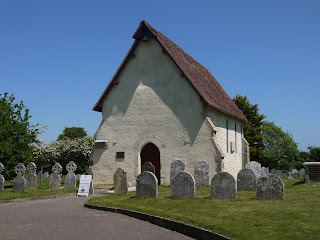
up with each other at St Wilfrid’s Chapel in Church Norton. This is now a
disused church that resembles a cemetery chapel but was originally the parish
church for Selsey until all but the chancel was removed in 1866 to form the new
parish church that is more central to the modern town. What is left of the chapel was rededicated to
St Wilfrid, a Saxon Priest who did much to promote early Christianity to the
area around Selsey. The remaining part
of the Chapel is also a Grade 1 listed building.
 |
| Sea Cabbages |
We took a
look inside and it was delightful. The
stained glass windows looked particularly radiant and we particularly liked
their theming, with scenes of wildlife and historical events as well as the
usual religious ones.
 |
| Sea Kale Flowers |
The
churchyard was still pretty active, with a number of people coming to tend
graves, many of which looked new and suggesting that this is not a holy place
that has been pickled in aspic but is still very much in use. Just outside though is a rather older feature
that is probably overlooked by all but the most observant of visitors; a large
motte and ditch from an early fortification.
This apparently once housed a Norman Keep but all trace of that has long
since disappeared, leaving only the earthworks and an interpretive board to
show how it must once have looked.
 |
| Bladder Campion |
After our
little detour into the church we headed back to the shore and found ourselves
walking along a beach of sorts around the edge of the harbour. The children decided that they would begin
filming themselves in a documentary as they walked along this stretch of the
shore. There manner seemed very much
like that adopted by presenters on Blue Peter; maybe some of the techniques had
rubbed off on them? When I played the
footage back later much of what I saw was blue sky as they had failed to point
the camera in an interesting direction as they spoke!
 |
| Railway Carriage Home |
At the far
end was the large shingle bank that forms the spit across Pagham Harbour
 |
| Eric Coates |
The kids
were very happy with their conversations behind us but by the time we got into
Selsey though it was clear they were flagging a bit so we got them an ice cream
to perk them up a bit. Some sit down time acted as a pick me up and we
walked along the seafront of the southernmost part of our County enjoying the
boats bobbing on the sea by the lifeboat station. Unusually because of the flat terrain around
here the lifeboat station is housed in a building at the end of a lengthy
pier. This always provides good photo
opportunities and on a sunny day like this it looked particularly good.
 |
| Selsey Lifeboat Station |
Just
beyond the lifeboat station we came across a group of people all huddling
around something on the beach. As we got
closer we saw that it was a seal and we were a little concerned that it was
being bothered by unthinking people. We
gave it a wide berth but later I discovered that the seal is a regular visitor
to the shore and seems to be quite tame around people. I suppose this is quite fitting considering
that the name Selsey means ‘island of the seal’.
 |
| Heading out of Town |
We were
cut short in our trek along the seafront as part of the front is actually
privately owned and we didn’t much fancy walking along the pebbles. We debated whether we should get the bus the
last couple of miles back but elected to continue as the girls still seemed
happy.
 |
| Medmerry Mill |
We skirted
around through the streets before getting back to the seafront about half a
mile further on. Just past the coastguard
station we headed out onto what passes as cliffs in these parts, although to be
honest they barely qualify as they are only about 10 metres high. The view ahead was now dominated by Medmerry
Mill and beyond the Spinnaker Tower could be seen in Portsmouth, the Isle of
Wight and the Palmerstone Forts that guard the strait between the island and
the mainland also known as Spithead.
 |
| Sea of Yellow |
We only
walked as far as Medmerry Mill, a fine looking place that is not one of the
more heralded windmills in Sussex Sussex
Coast
 |
| Pagham Hide View |
The onward
walk from the Mill back to the nature reserve was a lot less pleasant than we
had hoped for. Initially the route took
us around a few back roads before we finally managed to get back on a footpath
that followed the course of the old Selsey Tramway for a bit (not that you
would have known – it looked just like any other path!). After some more road walking the path crossed
several fields of very little note before we reached the car once again. In hindsight we should have spared us all the
last couple of miles of the walk back to the nature reserve. It was far
less interesting and rather further than the girls could comfortably manage.
Being the troopers they are though they managed to complete the walk
though. Next time I think we’ll use the
bus for the less interesting part of the walk!


